 Dink
Open play rotation: fair partners and sit-outs without a clipboard
An open play rotation answers two questions every round: who plays with whom, and who waits. Here is how to do it fairly, by hand or with the free generator.
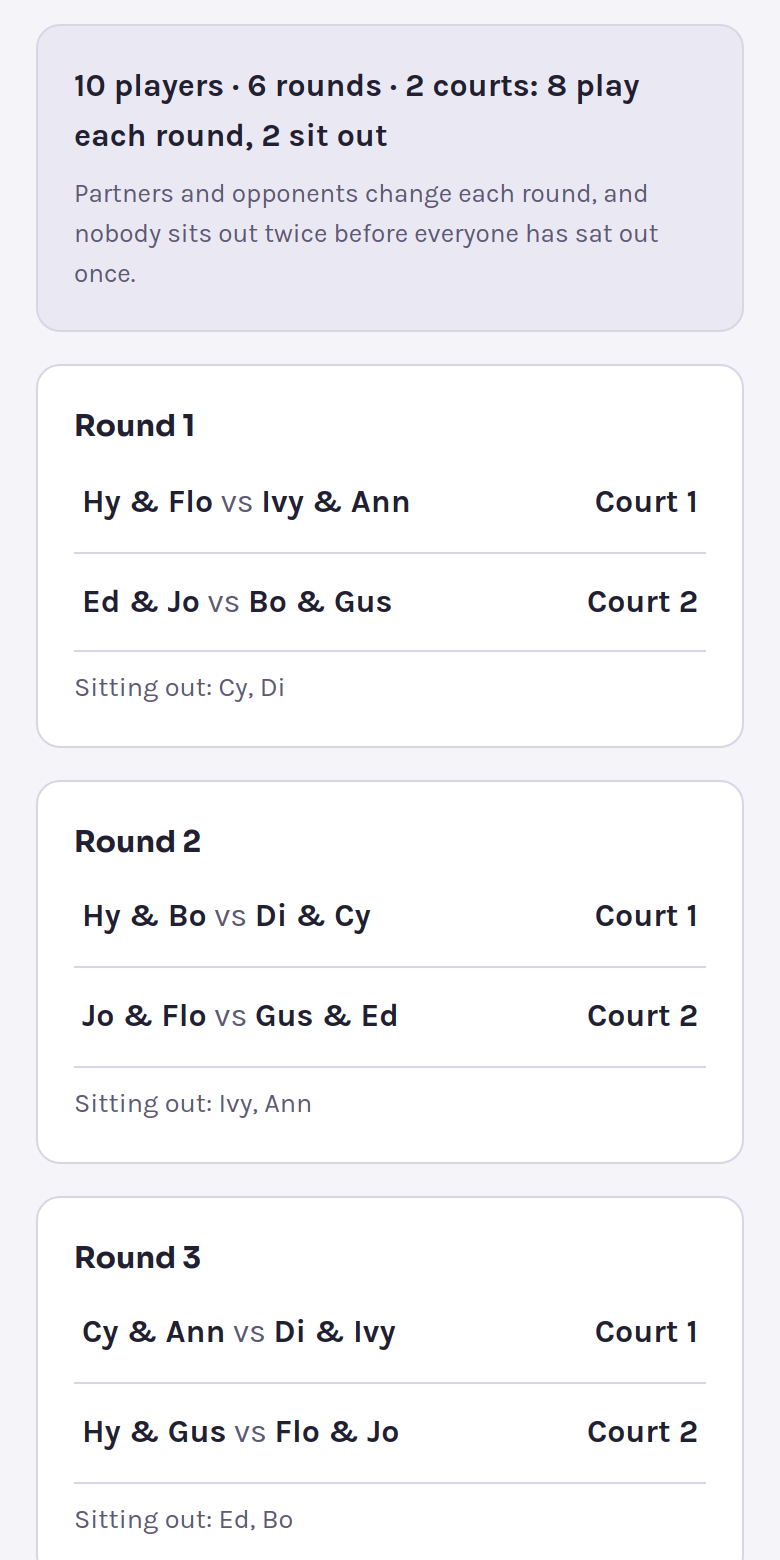
What a good rotation does
- Fills every court: four players per court, every round.
- Changes partners each round, so nobody plays all night with the same person.
- Changes opponents too, as far as the numbers allow.
- Spreads the waiting: nobody sits out twice before everyone has sat out once.
How many sit out
Each court holds four players. With 14 players and 3 courts, 12 play and 2 sit out each round. Seven rounds give each of the 14 players exactly one sit-out. With 16 players and 3 courts, 4 sit out each round, and four rounds give everyone one sit-out.
When the count is not a multiple of four, somebody always waits. A paddle stack at the gate handles that by arrival order. A rotation sheet handles it by count, so the person who already sat does not sit again first.
| Players | Courts | Play each round | Sit out each round |
|---|---|---|---|
| 10 | 2 | 8 | 2 |
| 12 | 3 | 12 | 0 |
| 14 | 3 | 12 | 2 |
| 18 | 4 | 16 | 2 |
| 22 | 5 | 20 | 2 |
Mixer or king of the court
A mixer deals fresh partners and opponents at random each round, with a penalty for repeats. It suits a social night with mixed levels.
King of the court ranks the courts. Winners move up a court and split, losers move down, so similar levels end up together as the night goes on. It suits a group that wants competitive games.
Use the free open play rotation generator
The generator at /generator has an Open play rotation mode. Type one player per line, set the courts and the number of rounds, and it deals every round with the same mixer engine DinkBoard uses on the night. Print the sheet and tape it to the wall. Nothing is saved, and no account is needed.
The same list always gives the same rotation, so a second print matches the first.
Full guide: Run an open play night
When people arrive late
A printed rotation is fixed: a late arrival waits for a gap, or you print a new sheet. Inside DinkBoard, open play deals each round from who is checked in at that moment, so a walk-up plays in the next round and a player who leaves is no longer dealt.
Frequently asked questions
How do I make an open play rotation fair?
Keep track of sit-outs and partners. The players who have sat out the least sit out next, and new partners each round. The generator does both for you.
How many rounds should open play have?
As many as fit your court time. Plan on 15 to 20 minutes for a game to 11, so a two-hour session fits six to eight rounds.
Can I use it for king of the court?
The printed generator deals a mixer. King of the court needs each round's results to move players, so it runs inside a DinkBoard open play night.
Related guides
Run an open play night
Open play is the format with no draw: whoever shows up, plays. DinkBoard deals each round for you, keeps the partner mix fresh, and makes the sit-out rotation fair without a clipboard.
Round robin pickleball schedule: how to build one (with a free generator)
A round robin is the fairest small-field format in pickleball: everyone plays everyone, and nobody's day ends on one bad match. Building the schedule by hand is where it goes wrong - here is the method, the math, and a generator that does it for you.
Pickleball terms for new players: a plain-English glossary
New to pickleball, or new to running events? These are the words you will hear at the courts and see in DinkBoard, each in a sentence or two. The other guides link here the first time they use one.
Need to run the event, not just plan it? DinkBoard builds your draws, schedules every match across your courts, and puts a live court board on every player's phone. Free while we're in early access.
See how it works Run an event